

This article was first published in Behavioral Health News
This person described how he voluntarily walked into a rehab facility after his last binge. He was not intoxicated. He was scared, exhausted, and asking for help. At intake, he was told he did not meet the clinical threshold for residential treatment. He, like most patients, was evaluated against the American Society of Addiction Medicine’s (ASAM) six dimensions of patient placement and was found too stable across too many of them. His motivation to change, the very thing we tell people they need to recover, was cited as evidence that he didn’t require a “protective environment.”
The first time I watched the recovery system harm someone in real time, it was not a mistake. It was merciful advice in the face of restrictive policy.
A clinician in the room, who once stood on the other side of the intake desk herself, pulled him aside and told him the only thing she knew would be helpful: unless he returned and screened positive (even just the faintest trace) his Medi-Cal coverage would not authorize admission. The person whose job was to save his life was telling him to just go take one more hit. Not because she wanted to, but because it was the only workaround left. Some might call it reckless, but that clinician likely saved his life.
Hours later, he was back in his car, hunting methamphetamine.
This is not an isolated story. The cruelest irony is that willingness, a person’s readiness to change, is cited across the recovery field as one of the strongest predictors of treatment success. Alcoholics Anonymous (AA) names it. The Substance Abuse Mental Health and Services Administration (SAMHSA) measures it. Every intake counselor asks about it. And yet under Medi-Cal, that same willingness becomes grounds for denial. He was ready. That’s why he was turned away. This is the core contradiction of addiction care.

As someone who has personally navigated this system and has nearly two decades of advocacy experience, I am not surprised. The American health care system has a documented tradition of sustaining policies known to cause harm, provided those being harmed are communities it has already deemed expendable. But Medi-Cal’s coverage criteria have been rewritten before. Women, particularly Black women, successfully pressured Centers for Medicare & Medicaid Services (CMS) to extend postpartum Medicaid coverage from 60 days to 12 months for a population the system had similarly discarded.
History shows that in order to change policy, those most impacted must be at the core of driving change, which is a tall order for a group consistently told they are powerless.
When “Trauma-Informed” Causes More Harm Than Good
Many institutions claim to be trauma-informed. Staff are trained. Language is careful. Décor is soothing. But lived reality tells a different story.
Using trauma-informed language within a punitive system does not make that system trauma-informed. It slaps a fresh coat of paint over a faulty structure that punishes honesty and surprises patients with protocol-induced abandonment the moment they need support most. True trauma-informed care requires predictability, emotional safety, and stability.
In the fentanyl era, these contradictions are not merely ethical, they are fatal. When someone achieves abstinence in a controlled setting, their opioid tolerance drops significantly. If that same person then loses housing, treatment, and community support after a relapse, they often return to their previous dosage in an uncontrolled environment. Lost tolerance combined with isolation and depression is one of the strongest predictors of fatal overdose, confirmed by the World Health Organization (WHO) and documented in Addiction Science & Clinical Practice. A model that claims to prioritize life cannot sustain policies that predictably increase mortality.
Measuring Compliance ≠ Measuring Healing
These practices persist because we measure the wrong things. SAMHSA’s own research (reported by LA County) tells us that only one in five people with substance use challenges ever seek formal treatment, leaving 80% invisible to the system. When 80% of the people are not responding to a system, the failure cannot be individual. It is inherently systemic.
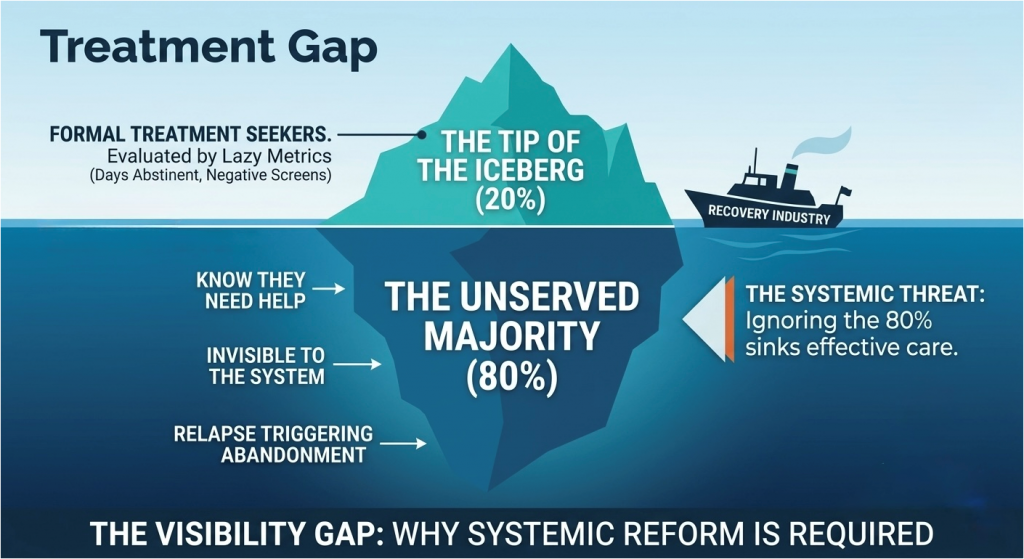
For those who do engage, care is governed by what I call lazy metrics: days abstinent, negative drug screens, length of stay. These are easy to audit and deeply misleading. They track the absence of behavior, not the presence of healing. A person who remains abstinent while white-knuckling through each day is a success. A person who relapses but immediately seeks help and stays engaged is a failure. This framework incentivizes performative sobriety.
Part of what sustains this is philanthropy. Not because funders don’t care, but because they are operating on assumptions about addiction that haven’t been examined in nearly a century. The metrics mentioned above appear in logic models and board presentations because they are legible and auditable. But they also measure the wrong end of the process, documenting failure after it has already occurred, rather than tracking whether healing is growing. Until philanthropy funds organizations that measure presence instead of absence, the system will keep producing the same outcomes.
“The opposite of addiction is not sobriety. It is connection.”
— Johann Hari
That line landed back in 2015 because it named something practitioners already intuitively knew. But it is not merely evocative. It is policy hiding in plain sight. Removing social support at the moment of relapse is not a neutral act; it is a known risk escalation pathway. Connection is not a therapeutic nicety. It is a neurological precondition. Without it, the nervous system cannot access the safety required to seek help, tolerate discomfort, or sustain change. We have built an entire system on the premise that people must earn connection through compliance. But this is backwards, especially when the science tells us connection is what makes compliance possible in the first place.
Honoring the Past While Advocating for the Future
Alcoholics Anonymous accomplished something extraordinary. In 1939, with no neuroscience to guide it, it built a portable framework for mutual aid that has helped millions. Its 12 principles mapped onto what we now understand as the core psychological conditions for change.
The science has since arrived, and it doesn’t contradict AA. It explains it. We now know why shame forecloses healing, why arts-based modalities bypass resistance, and why safety and belonging are neurological preconditions for change. The policy implication is not that AA failed. It is that we owe the next generation more than a framework built before we understood why it worked.
Medicaid reimbursement criteria need to reward sustained engagement rather than abstinence milestones. CMS has the authority to update value-based care metrics to reflect engagement continuity, and specifically, to revise how ASAM’s level-of-care criteria are applied in prior authorization decisions. As currently implemented, the ASAM framework denies residential placement to people most likely to benefit from early intervention: those presenting voluntarily, with motivation and partial stability. Rewarding crisis presentation while penalizing help-seeking is not a clinical standard. It is a reimbursement artifact masquerading as one.
This would not be the first time advocates forced a regulatory framework to confront that distinction. ACT UP’s intervention in FDA drug approval processes in the late 1980s during the HIV/AIDS crisis demonstrated that when advocates understand the mechanism well enough to name it precisely, the mechanism changes. Housing contracts must eliminate automatic discharge clauses tied to positive drug screens. Accreditation bodies like Commission on Accreditation of Rehabilitation Facilities (CARF) and The Joint Commission (TJC) should measure patient safety and connection, not compliance rates.

The field must also replace lagging metrics with leading ones. Three globally recognized psychometric tools are available right now: the Experiences Questionnaire (EQ), which measures decentering and cognitive defusion; the Brief Resilience Scale (BRS), which tracks capacity to recover from adversity; and the Multidimensional Scale of Perceived Social Support (MSPSS), which captures perceived quality of social connection. These are validated, peer-reviewed instruments used in behavioral health research worldwide. There is no clinical justification for not using them. The only justification for continuing to use days abstinent and negative screens is administrative convenience, and that is not a clinical argument.
My organization, A Beautiful You, a Los Angeles-based harm reduction nonprofit is built on exactly this premise. Our model uses arts-based modalities to guide participants through 15 dialectically paired sovereignty principles, expanding the framework of AA’s 12 spiritual principles into one that incorporates the neuroscience of trauma, regulation, and belonging. We eliminate behavioral reporting entirely. Participation requires no sobriety tests, no disclosure, and no performance. Pilot data from 222 participants showed a statistically significant medium-effect improvement in emotional wellbeing (p<.001, d≈0.5). We do not demand change. We create the conditions for it.
Care should not be conditional. Relapse should trigger presence, safety, and support, not homelessness and abandonment. A system that demands compliance before offering trust will continue to fail. We know what works. We know how to measure it. The only question left is whether the field has the courage to build it.
Belonging comes first.