The Missing Middle
The System Wasn't Built for Most People In Recovery
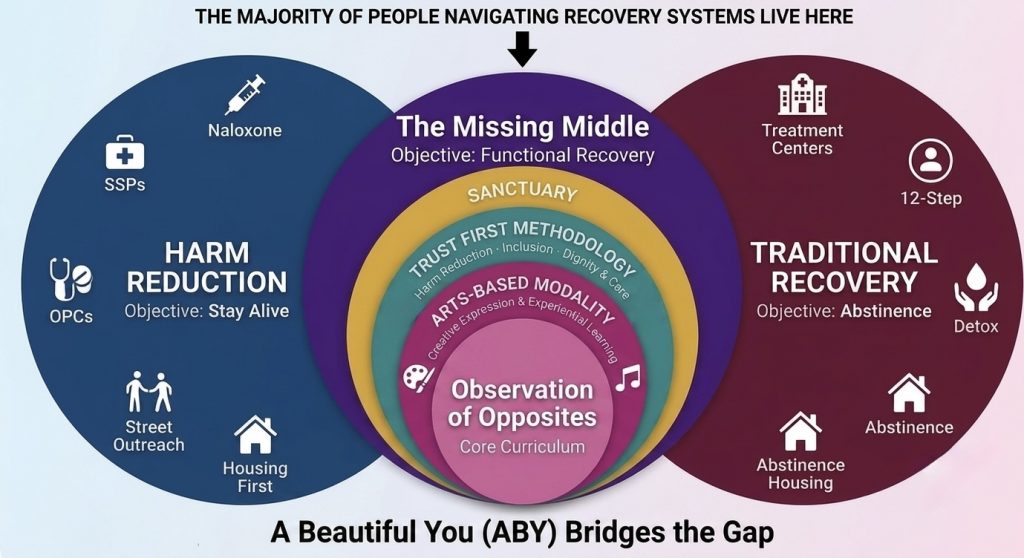
The majority of people navigating substance use challenges live between harm reduction and traditional recovery – in a space the behavioral health system has never fully served. ABY was built for them.
Two Systems.
One Enormous Gap
The behavioral health field has organized itself around two poles. Both are vital.
However, neither one was designed for the majority of people who actually seek help — those whose lives are complex, whose goals are self-defined, and whose relationship with substances do not fit a binary narrative.

Harm Reduction
Objective: Stay Alive.
SSPs, naloxone, OPCs, street outreach, Housing First. Essential, life-saving, and not designed to address functional recovery.
Traditional Recovery
Objective: Abstinence.
12-Step. Rehab, Abstinence-based housing. Effective for some and inaccessible or inappropriate for the majority.
The Missing Middle
Objective: Functional Recovery.
A population with no sobriety requirement who need belonging, behavioral health support, and a reason to keep showing up.
65.2%
Percentage of adults who self-identify as in recovery reported past-month alcohol or other drug use — meaning most us adults who consider themselves in recovery are non-abstinent.
Source: Nonabstinence Among US Adults in Recovery · PubMed 39792600 · 2022 NSDUH
94.7%
Percentage of the 39.7 million adults with untreated substance use disorders in 2022 reported either not perceiving a need for treatment or not wanting the exclusively abstinence-based options available to them.
Source: PMC11740499 · 2022 NSDUH · SAMHSA
80%
Percentage of people who needed treatment for a substance use disorder in 2024 did not receive it.
Source: SAMHSA · 2024 National Survey on Drug Use and Health